
Category: News

Power procurement entity’s big job

Although he spoke significantly on the matter during his recent parliamentary review of his portfolio, Daryl Vaz’s outline of plans for Jamaica’s electricity sector – including the Government’s intention to go the market for more renewable power generators and its broad strategy for the introduction of electric vehicles (EV) – seems to have by-passed most people.

That is unfortunate. For concomitant with, and in some respects, as guide to these critical developments, there should be a robust discussion about the strategic direction of the electricity sector. This must, among other things, cover explanations for our relatively low growth in electricity consumption (substantial theft of power notwithstanding) and why the price of power has not fallen at the rate, or to the levels, expected by consumers since the supplier’s investments in new generating plants and the introduction of liquefied natural gas as the sector’s main source of power-plant energy over three years ago.

In that regard, the work of the Generation Procurement Entity (GPE) – and the personalities behind it – must be transparent, rigorous, and inclusive. In other words, it must be open to all stakeholders, including consumers – and seen to be so.

As Minister Vaz, who has responsibility for science, technology, and energy, explained, the GPE is a creature of the 2015 Electricity Act. Its job is to guide the procurement of new generating capacity for the national grid, essentially doing what the former Electricity Sector Enterprise Team (ESET) undertook with regard to the policy on LNG and the Jamaica Public Service’s (JPS), the monopoly electricity transmission and distribution company, construction of a new, 190-megawatt plant at Old Harbour.

NEW GPE LEADERSHIP

The GPE, formalised in 2017 under the leadership of ESET’s last chairman, Professor Alvin Wint, has, since then, had a largely quiet existence. But according to Mr Vaz, the Government appointed “new leadership for the GPE, with a mandate to undertake procurement of new electricity-generation capacity”. A technical expert has also been recruited to support the entity.

“The GPE has been given the charge to get moving,” he said. “We want to see a significant increase in our generation capacity and our renewable energy share based on the Integrated Resource Plan.”

We sense an excitement in the minister’s declaration, which this newspaper broadly shares. Except that the public is mostly unaware of who the members of the GPE are, their backgrounds, and how they propose to pursue their mandate.

The job they are committed to undertake is important. Approximately 17 per cent of Jamaica’s power is generated from renewables. The plan, Mr Vaz said, is to increase that to 32 per cent by 2030, rising by a further 17 percentage points, to 49 per cent, over the next seven years. “The renewable-mix resources include solar, wind, hydroelectric, waste to energy, and biomass,” he said.

The Government estimates that the investment in renewables, and a broader modernisation of the electricity infrastructure, will require an investment of US$2.8 billion, or over J$420 billion at the current exchange rate. That is a lot of money on which those who invest it will, rightfully, seek an adequate return. Consumers will expect reliable, cheaper, and competitive electricity.

A clear positive in the pivot to renewables, which is happening globally, is that burning less fossil fuel is good for the environment, given the existential threat that global warming poses to small island states like Jamaica. Happily, the price of renewable technologies has been falling, increasing, on the face of it, the feasibility of investment of the value proposed by Minister Vaz.

SEVERAL ISSUES

But even as Jamaica proceeds on this inevitable path towards renewables, there are several issues that will have to be part of the discussion, especially if lower technology prices continue to lure larger consumers away from a grid in favour of their own production. In the face of any such migration, and largely stagnant growth in electricity consumption over the last five years, policymakers and the GPE will have to ensure the affordable delivery of electricity to household consumers who might not be able to leave the grid. Put another way, this project must be as much about affordable power in an expanded market as it is about clean power. Indeed, competitive power is good for the national economy and social equity, but also in the context of fairness to the suppliers of the commodity.

In this regard, the development of policy to encourage the use of EVs in Jamaica must be accelerated. Mr Vaz announced that he had established a council “to oversee a consultative process on the introduction of electromobility”. That is encouraging. But names and a work plan must be placed on that council. There must also be public discussion on the questions raised by the Office of Utilities Regulation in its consultation document on EVs such as what the Government will do to make electric cars affordable to Jamaicans and what policy should cover the public charging ports.

The bottom line is that there are still big, exciting conservations to be had about Jamaica’s electricity-generating sector in the age of renewables.
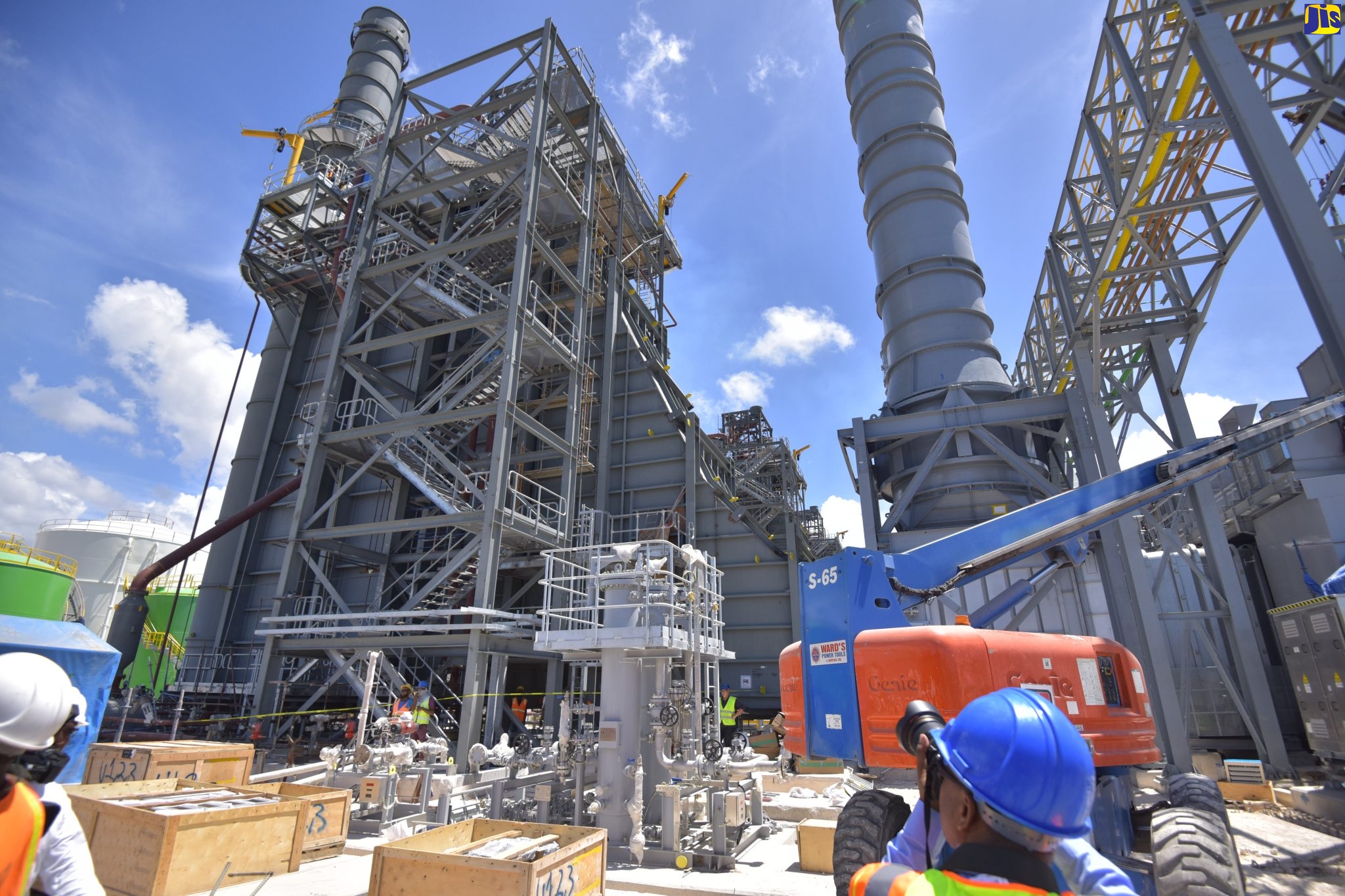

JPS Pushing For Cleaner Energy Generation In Jamaica

On December 17, 2019, the Jamaica Public Service Company (JPS) commissioned a new 190-megawatt (MW) natural gas power plant in Old Harbour, St Catherine, propelling Jamaica towards the realm of cleaner, efficient energy.

The plant generates electricity using natural gas and is the most efficient fuel-burning power plant in the island.

President and Chief Executive Officer of JPS, Emanuel DaRosa, tells JIS News that the US$315-million power plant was a huge advancement for Jamaica.

“Older power plants are in some cases 40-50 years old and this brand-new power plant’s efficiency is twice that of the 40-year-old power plant it replaced. It produces the same amount of energy with half the amount of fuel,” he explains.

The plant is operated by South Jamaica Power Company (SJPC), a JPS affiliate, and was renamed the South Jamaica Power Centre after it was commissioned.

It is the second power plant in Jamaica to operate on natural gas, following the conversion of JPS’s Bogue Power Station in Montego Bay from automotive diesel oil in 2016.

More than 470 Jamaicans were employed to work on the plant during its construction, for which ground was broken in March 2017. The Combined Cycle Power Plant can support 300,000 homes and can use automotive diesel oil as a backup fuel.

“From an environmental perspective, the particulate reduction is approximately 90 per cent with this plant because it uses natural gas. When this plant is in operation you can’t tell if one, two or three units are in operation as opposed to the older plants where you could tell which units were operating based on the smokestack,” Mr. DaRosa says.

Studies have shown that natural gas is environmentally friendly because it burns cleaner than other fossil fuels such as diesel. It’s safer, less expensive and easier to store when compared to other fossil fuels.

“This plant offers much greater flexibility; its ability to turn up and down is much greater than some of the older power plants, which would take six to 10 hours to come online and would have to be on for a minimum of 12 hours, so the ability to schedule them on and off wasn’t there,” the Chief Executive Officer states.

Mr. DaRosa notes that a top priority for JPs is to move away from a strong dependence on heavy fuel oil (HFO) and invest in other sources of energy such as natural gas and renewable energy.

“Our overall investment strategy focuses on fuel diversification, moving away from a 95 per cent reliance on fuel oil. The volatility of oil has taken this country to prices of electricity such as US$0.40 to $0.45 cents per kilowatt per hour. We’re not there today, but we could get there again if we don’t continue to diversify our fuels. With the older plants, we couldn’t integrate renewables the way we do today, given this new power plant,” he says.

The newly commissioned plant supports the national goal of cleaner energy and is expected to stabilise electricity costs over the long-term while enabling energy security for the nation.

“Over the next three years, we will be working on a 40-kilometre 38-kilovoltage transmission line that’s going to connect old Harbour to Kingston. When you put all that we do together, you see that we are an important part of building this nation and helping it move forward and we are looking to work closely with the Government and other energy partners to do so. We’ll move this grid forward and bring it into the 21st century,” Mr. DaRosa shares.

He explains that with the planned retirements of older plants and the growing energy demand in the Corporate Area, the electric grid will not be able to safely or economically supply customers without a new transmission line to bring a majority of the power from the generation facility in Old Harbour.

The electric energy for Kingston is usually generated from the Hunts Bay station. However, JPS plans to decommission part of the plant, which was built over two decades ago.

The Hunts Bay plant is scheduled to be decommissioned by 2023, and feeding power from Old Harbour to Kingston is not expected to negatively impact the St Catherine communities.

“We’re going to spend more than US$100 million over the next five years to rehabilitate the grid, and this does not reflect some of the generation investment we’re going to have to make. We have a 171-megawatt, right of first refusal generation (plant) [which] we will be operating shortly,” Mr. DaRosa informs.

He underscores that “there is a tremendous amount of investment going on in the energy field, and the Old Harbour Power plant was just one example”.

JPS is the sole distributor of electricity in Jamaica and is a partially State-owned company. It owns and operates four power stations, nine hydroelectric plants, and one wind farm across the island, and serves over 640,000 customers each day.

Cabinet Appoints New Generation Procurement Entity Members

Cabinet recently appointed seven (7) members to serve on the Generation Procurement Entity (GPE), which was established in The Electricity Act, 2015.

The entity will be headed by Professor Alvin Wint, Emeritus Professor of International Business, UWI, as Chairman. The other members are: Mrs. Helene Davis White, President of the Jamaica Confederation of Trade Unions; Dr. Wayne Henry, Director General, Planning Institute of Jamaica; Mr. William Mahfood, Chairman, Wisynco Group; Mr. Paul B. Scott, President of the Private Sector Organisation of Jamaica; Mrs. Rosemarie Pilliner, Executive Vice President, Scotia Group and the Director of Electricity Generation Procurement, Ministry of Science, Energy and Technology (MSET).

The GPE, which reports to Cabinet, has responsibility for managing the replacement of existing electricity generation capacity and the procurement of new capacity.

The membership GPE is that of the previous Electricity Sector Enterprise Team (ESET).

The work of the ESET came to an end with the fulfilment of its mandate to facilitate the urgent replacement of baseload electricity generation capacity with lower cost fuel sources.

The ESET also recommended the manner in which future electricity generation procurement should be managed.